


Key takeaways
- Most enterprise data sits across documents, emails, and spreadsheets in unstructured formats. Managing this at scale is what enterprise document management solves.
- It runs as a five-stage workflow: capture, indexing, storage, automation, and delivery. Each stage turns raw business data into organized, audit-ready documents.
- The automation stage is where most teams miss value. Generating documents from a live CRM or HR management system removes the manual re-entry step entirely.
- Teams creating 50 or more of the same document each month are the clearest fit.
- Docupilot handles the automation layer, connecting to 70+ tools like Salesforce and BambooHR. It pulls live data into templates and routes documents to signature.
An enterprise document management system (enterprise DMS) is the platform that handles every document your organization creates, stores, and sends. It covers where a document starts, how it gets built, who reviews it, and where it lives after delivery.
The workflow runs across five stages:
- Capture
- Indexing
- Storage
- Automation
- Delivery
Each stage makes a specific decision about what happens to a document and who is responsible for it. Building these stages into a repeatable document management workflow is what turns scattered files into an audit-ready system.
This guide walks through all five stages. It explains the difference between document management and document automation. It also covers the four signals that indicate your organization has outgrown its current document process.
Enterprise document management vs. basic document management: what's the difference
Most organizations start with shared drives like Google Drive, Dropbox, or SharePoint. You upload files, sort them into folders, and give your team access. Shared drives basically store files.
A basic document management tool goes one step further. It adds version history, tagging, and permission controls on top of storage. These tools work well for small teams with steady, low-volume document needs.
An enterprise document management system works at a different level. It treats each document as part of a workflow. Examples include a contract linked to the deal record that created it, an offer letter tied to the employee record in your HR system, and a signed agreement saved to the client folder on its own, with a log of every action taken on it.
Three capabilities separate an enterprise system from shared drives and basic document management tools:
- Scale: It handles thousands of documents a month without manual filing or tagging.
- Integration: It pulls data from your CRM, HR platform, ERP, or spreadsheets straight into templates.
- Compliance: Every action is logged, versioned, and traceable for HIPAA, GDPR, SOC 2, and eIDAS.
How Enterprise Document Management Works
Each stage handles a specific part of a document's life. Here is what happens at each one:
Stage 1 - Capture and ingestion
Every document workflow starts with data arriving from somewhere. How the data arrives decides whether a person has to handle it or whether the system handles it automatically. This is the difference between the two capture types below.
- Passive capture occurs when a team member uploads a file to a designated folder or scans a paper document into the system.
- Active capture fires when a connected application triggers document creation automatically.
Active capture saves more time than passive capture because it removes the human step entirely.
For example, when a new employee record is created in BambooHR, the system pulls the hire's name, title, start date, and salary straight into an offer letter template. The document is ready the moment the record is saved. No one has to open a template, type in the name, or attach the file.
The AI-assisted version of active capture
Active capture pulls data from systems that already have it organized, like a CRM or HR platform. AI-assisted capture goes further. It can read documents where the data sits in plain text, like scanned contracts, paper forms, or PDF invoices. The system finds the fields on its own and feeds the data into templates the same way. Even documents that start on paper get captured without anyone typing them in.
Stage 2 - Indexing and metadata
Imagine your team uploads a contract into the system. After six months, if someone needs to find it, how do they search for it?
If the contract was saved with just a filename, the only way to find it is to remember the exact name or the folder it is in. Now imagine doing that with 10,000 contracts. Nobody can find anything.
This is the problem indexing solves. When a document enters the system, it gets labeled with details that describe it. For a contract, those details might include the client's name, the type of contract, the date it was signed, and the date it expires. These labels are called metadata.
Once every document has this kind of labeling, you can pull up every contract that you wish at any time without having to remember the exact details.
Stage 3 - Storage and version control
Storage is where the document physically lives after it enters the system. There are three main options for where documents are stored.
- Cloud storage means the documents live on servers run by the vendor, like Google Cloud. Your team accesses them through a browser or an app over the internet.
- On-premise storage means your company owns the computers where the documents are saved. These computers sit inside your own building or a private space your company controls.
- Hybrid storage uses both. Some documents stay on your own servers for security or compliance reasons, and others live in the cloud.
Most organizations store documents in the cloud. Cloud storage handles security in three main ways.
- Encryption turns your documents into unreadable code while they are stored. Only people with the right login credentials can unlock and read them. The current industry standard, AES-256, has the same level of encryption used by banks and government agencies.
- Role-based access control (RBAC) decides who is allowed to open which documents. For example, a junior employee in your sales team can see contracts in their own region. A senior manager can see contracts across every region they oversee. Someone in HR cannot see sales contracts at all.
- Data residency is the rule that says which country your documents are physically stored in. If your customers are in Europe, GDPR may require their data to stay on servers inside the EU. If you handle US healthcare data, HIPAA has its own rules about where that data lives.
Version control is the second half of this stage. Without it, your team runs into the "which file is the latest one" problem every time someone updates a template or a contract.
Without version control, different team members might send out different versions of the same contract. With version control, the system always shows the latest approved version. Older versions are saved in the background with a record of who changed them and when. If you ever need to go back to an older version, you can do so, with just a click.
Stage 4 - Workflow automation and document generation
The first three stages deal with documents that already exist. Stage 4 is where the system creates new documents from your live data. The breadth of these document generation capabilities determines how much of your paperwork the system can produce end to end.
Automation handles two jobs.
- Document generation fills in a template using data from your CRM, HR system, or spreadsheet. Placeholders like client name, contract value, and start date get populated automatically.
- Routing sends the finished document to the right people for approval and signature. The order is set in advance, so nobody has to forward emails to any person at any step manually.
For example, when a deal is marked "closed-won" in HubSpot, the system pulls the client details, fills in the contract template, sends it to the sales manager for approval, and routes it to the client for signature. The whole chain runs without anyone opening a Word file.
This is the stage where most teams lose the most time. Without automation, every document is built by hand and every signature is chased one at a time.
Document automation handles a big share of the manual work teams do every day. McKinsey research shows that 30% of the activities in 60% of jobs could be automated using current technology (McKinsey, 2024).
Stage 5 - Delivery and audit trails
Once a document is approved and signed, the system delivers it. The client gets a copy by email. A second copy is saved to your cloud storage, a third is attached to the CRM record for that deal, and a fourth is archived for compliance. All of this happens in one step, without anyone forwarding files.
While delivery is happening, the system is also keeping a record of everything. It includes details like who created the document, who reviewed it, who signed it, when each action happened, and from which device. This record is called the audit trail.
The audit trail is what your team uses if questions come up later. If a client disagrees about a contract or your company gets audited, the audit trail is the proof of how the document was handled.
Some industries are also required by law to keep this kind of record. Healthcare companies must follow HIPAA. Companies that handle European customer data must follow GDPR. Software companies that store client data must follow SOC 2. An audit trail is part of how a business proves it follows these rules.
Before choosing any enterprise document management system, check what security certifications it has and make sure they match what your industry needs.
Four signs your organization needs an enterprise document management system
Most teams start with a shared drive and a few templates. At some point, that stops working. These are the four most common signs you have reached that point.
1. Your team creates the same document hundreds of times a month
Some teams send out the same kind of document over and over. An HR team might generate 160 employment contracts a year, each with a different name and start date but the same structure underneath. Done by hand, the work piles up fast.
Morristown Beard School ran into this with their HR team. Before automating, contract generation, follow-ups, and signatures were all manual. After connecting their Airtable records to a contract template with built-in digital signing, the team sent seven contracts in 30 minutes. Five came back signed almost immediately.
2. Your document workflow depends on one person
In many teams, one assistant or one operations coordinator is the only one who knows how to send out a contract. When that person is on PTO, sick leave, or buried in a busy week, contracts stop going out.
An enterprise document management system removes that dependency. Once the template is built and connected to the data source, anyone on the team can trigger a document. The person who used to be the single point of contact now owns the template, while the rest of the team handles the sends.
3. Your team copies CRM data into Word templates by hand
Your Salesforce or HubSpot already has the client name, deal value, and contract terms in it. Someone on your team still opens a Word file and types each one in.
A live connection between the CRM and the template fixes this. When a deal moves to a specific stage, the document gets generated with the right data already filled in. This is what data source integrations do.
4. An audit found gaps in your document records
You were audited, and your company could not show who created, approved, or signed a specific document. For teams in healthcare, finance, real estate, and legal, this gap turns into liability fast.
An enterprise document management system records every action on every document. When the next audit comes, the record is already there.
What to look for in an enterprise document management system
Here are the five things to check before signing a contract with any enterprise document management vendor.
- How well it connects to your existing tools:
Most teams have a CRM, an HR platform, and a few other tools they cannot replace. The platform you choose has to connect to all of them.
List your daily tools and confirm each one connects natively before you sign anything. If a connection is not native, the vendor has to build a custom one, which takes more time and money to set up.
- What compliance certifications it holds:
If your company is in healthcare, finance, or any regulated industry, the platform needs specific certifications.
The most common are SOC 2 Type II, ISO 27001, HIPAA, and GDPR. Look for these on the vendor's public trust center.
- What pricing actually looks like at your real volume:
Many platforms charge a fee for every person on your team who uses the platform. Some charge a base price and then add extra fees for the features your team actually needs.
Before you sign, ask the vendor what the total bill will look like for your real number of users and your real number of documents per month.
- Whether it generates new documents from live data:
Some platforms handle storage and organization only. Generating new documents from a CRM or HR system is a separate capability that some platforms include and some do not.
If your team needs document generation from live data, confirm whether the platform supports it before signing.
Docupilot: enterprise document automation, built to connect
Here is what Docupilot offers for enterprise document automation:
- AI-powered template builder: Create a template by describing what you need. Docupilot's AI generates the structured template for you, ready for merge fields and formatting tweaks.
Image:

- Microsoft Word Add-In: Templatize an existing Word document directly inside Word, insert merge fields, validate templates, and sync to your Docupilot account without leaving the editor.
- 70+ native integrations: Docupilot integrates natively with Salesforce, HubSpot, BambooHR, Airtable, Google Sheets, and many other tools. For anything else, you can use Zapier, Make, webhooks, or open APIs.
Image:

- Conditional logic for document variations: Build one master template. Docupilot adjusts it for each document based on the data pulled from your CRM, HR system, or spreadsheet. For example, the same contract template can use different terms for US clients and UK clients. It can also use different pricing for enterprise accounts and small-business accounts.
- Built-in eSignature: Send documents for signing, track status in real time, and capture legally binding signatures without switching to another platform.
- Multi-format output: Generate documents as PDF, Word, PowerPoint, Excel, or fillable PDF, depending on what the recipient needs. For one-off needs, you can also convert a spreadsheet to PDF free, no account required.
- Bulk document generation: Produce hundreds of unique documents from a CSV or spreadsheet in one batch.
- Enterprise-grade security and compliance: SOC 2 Type II, GDPR-compliant, and HIPAA-ready, with end-to-end encryption, audit trails, and role-based access controls.
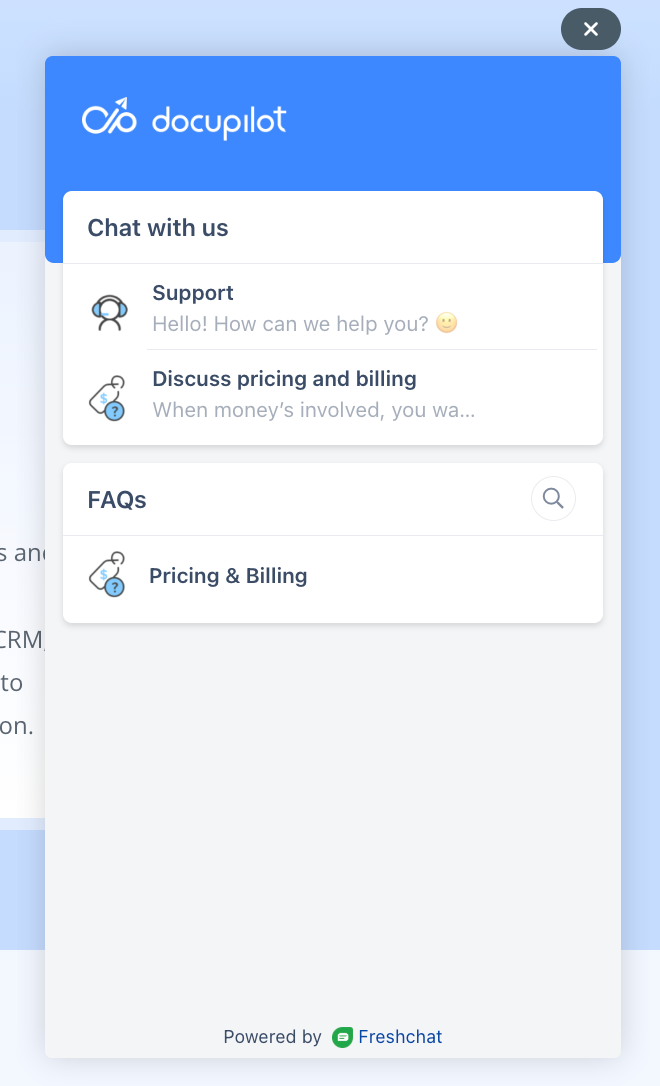
- 24/7 chat support. Real humans, available around the clock, with remote video call sessions when teams need hands-on help.
See what teams using Docupilot are doing with it:
Sunnon & Charlotte Property Management connected their property database to their lease templates. Lease preparation time dropped by 80%.
Massive Agency reduced document processing time from 30-60 minutes per document to a few minutes, and now generates over 10,000 documents a year.
Move from manual document work to a system that runs itself
Manual document work is the most expensive habit in most operations teams. Docupilot replaces that habit with templates that build themselves from the data you already have.
With the right setup, a single template can generate hundreds of contracts, proposals, or offer letters in minutes, with zero errors and full audit trails on every document.
While shared drives and basic document tools can handle small teams, enterprise-grade automation is where the real time savings live. Docupilot connects directly to your CRM, HR system, and spreadsheets, supports conditional logic for document variations, enforces approval workflows, and meets SOC 2, GDPR, and HIPAA requirements right out of the box.
If you are ready, sign up for Docupilot's 14-day free trial and start automating your first batch of documents today.
FAQ
What Is the Difference Between EDM and ECM?
Enterprise document management (EDM) focuses on structured business documents like contracts, invoices, reports, and compliance forms. Enterprise content management (ECM) covers a broader scope including multimedia, emails, web content, and records. EDM is a subset of ECM.
How Do Enterprise Document Management Systems Improve Organizational Efficiency?
They reduce manual data entry, eliminate version control errors, automate approval routing, and enforce consistent formatting across every document. Organizations with higher document automation report 25% faster processing times for key business documents (IDC, 2024).
What Companies Need Document Management?
Any organization generating more than 100 structured documents per month across departments like legal, HR, finance, or operations. Regulated industries including healthcare, financial services, real estate, and insurance have the strongest compliance-driven need.
Is Cloud-Based Enterprise Document Management Secure Enough for Regulated Industries?
Yes, when the platform holds certifications like SOC 2 Type II, ISO 27001, HIPAA, and GDPR compliance. Verify encryption standards, audit trail capabilities, role-based access controls, and data residency policies before committing.
What is the difference between enterprise file management and enterprise document management?
Enterprise file management covers file storage, organization, and access controls. Enterprise document management covers the same things and also handles how documents get created, reviewed, delivered, and kept audit-ready over time. File management is a subset of document management.
Learn how to automate document creation with Docupilot


Contents
Stop rebuilding the same document by hand.

Generate and sign in one workflow.
Fifteen minutes back, per application.