





Key takeaways
- UETA and the ESIGN Act serve different roles: UETA governs electronic signatures at the state level, while the ESIGN Act ensures enforceability across states and online transactions
- Consent and intent drive enforceability: Legally binding electronic signatures depend on clear consent, demonstrated intent, and reliable record retention
- ESIGN-first workflows reduce risk: Designing for ESIGN ensures compliance with both laws, minimizing legal risk
- The right platform simplifies compliance: Document automation tools like Docupilot embed consent and audit trails, making electronic signatures enforceable
Electronic signatures are now standard across the US. Contracts get signed in minutes. Insurance forms, HR documents, vendor agreements, and disclosures all move faster than ever.
Yet one question keeps coming up for businesses adopting digital workflows: which law actually makes electronic signatures legally binding?
Some point to the Uniform Electronic Transactions Act (UETA). Others rely on the ESIGN Act. Many assume the two are interchangeable. They are not.
The difference affects enforceability, consent requirements, and how confidently businesses can automate document workflows. Together, UETA and the ESIGN Act form the legal foundation for electronic signatures in the US.
This post breaks down UETA vs ESIGN Act in plain terms, explaining what each law covers, how they work together, where they differ, and what teams need to stay compliant. It also looks at how modern document automation platforms like Docupilot support compliance while keeping pricing transparent and predictable.
What is the Uniform Electronic Transactions Act?
UETA is a state-level law that ensures contracts and records remain enforceable even when created or signed electronically.
What UETA covers
UETA applies when all parties involved in a transaction agree to conduct business electronically. Its core principles are:
- Electronic signatures carry the same legal weight as handwritten signatures
- Electronic records are recognized as equivalent to paper
- Contracts remain valid even when signed or stored electronically
- Intent and consent matter more than the technology used
UETA is technology-neutral. It focuses on process, emphasizing how consent is given, how intent is demonstrated, and how records are retained over time.
Where UETA applies
UETA governs intrastate transactions when the state has adopted the act and all parties consent to electronic records.
Common use cases include:
- Insurance forms and policy acknowledgements
- Vendor and supplier agreements
- HR documents and employee onboarding forms
- Internal approvals and authorizations
However, UETA only applies if both parties agree to use electronic records. If one party requires paper, UETA protections may not apply. Certain document types may also fall outside its scope depending on state rules.
These limitations explain why UETA alone does not cover every electronic transaction, especially for businesses operating across state lines.
What is the ESIGN Act?
The Electronic Signatures in Global and National Commerce Act (ESIGN Act) is a federal law that establishes the legal validity of electronic signatures and electronic records across the United States. It provides a nationwide baseline when transactions cross state borders or when state law does not clearly apply.
The ESIGN Act confirms that:
- Electronic signatures are legally binding
- Electronic records satisfy legal requirements for written documents
- Contracts cannot be denied validity because they were signed electronically
ESIGN Act requirements for businesses
For consumer-facing transactions, the ESIGN Act sets stricter requirements for consent and disclosure. Businesses must ensure:
- Clear, affirmative consent
- Disclosure of the right to paper copies
- Information on how consent can be withdrawn
- Record accessibility
Failing to meet these conditions can weaken enforceability, even when a signature exists.
Where the ESIGN Act applies
- Interstate business transactions
- Online contracts and digital agreements
- Transactions involving parties in different US states
States may adopt UETA in a manner consistent with ESIGN, allowing both laws to operate together. This overlap often causes confusion, but it is intentional and ensures electronic signatures remain enforceable across varying scenarios.
Key differences between UETA and the ESIGN Act
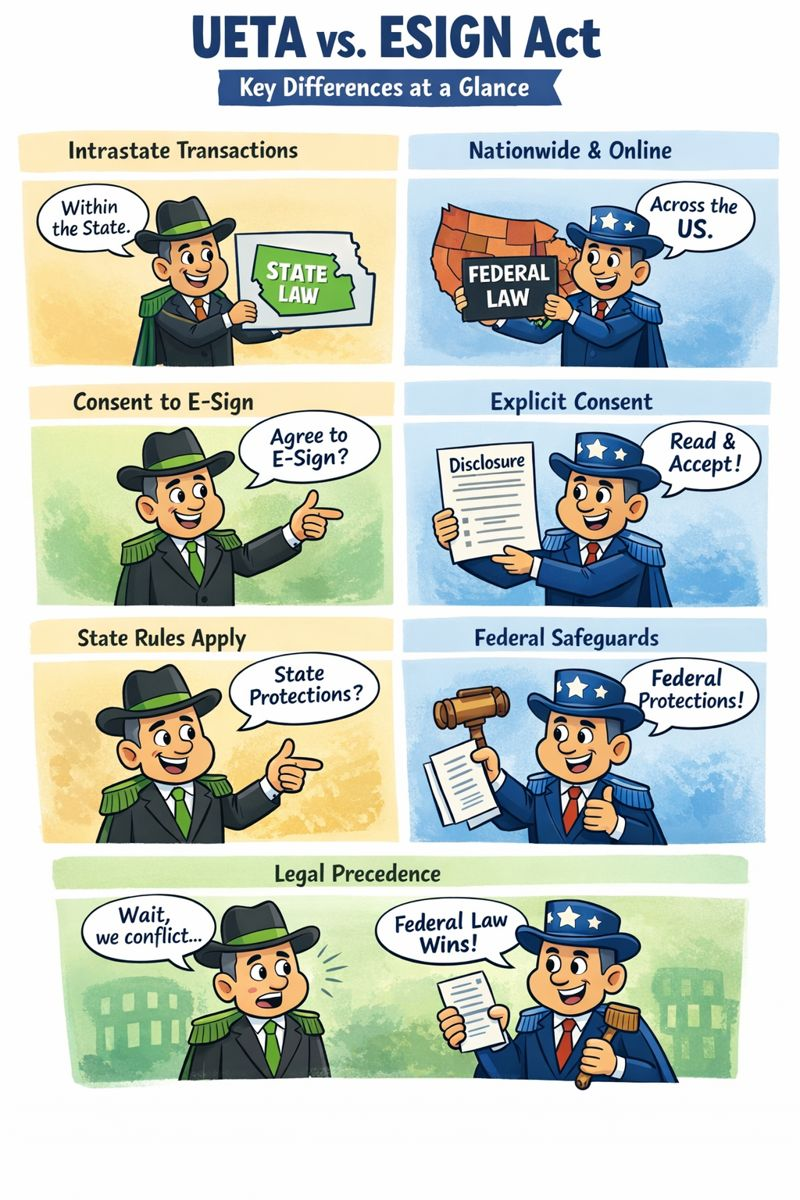
The following section breaks down the ESIGN Act vs UETA differences that affect consent, enforceability, and interstate transactions.
- Scope and jurisdiction: UETA is a state law governing intrastate transactions, while the ESIGN Act is a federal law that applies nationwide
- Consent requirements: UETA requires agreement to transact electronically, while the ESIGN Act requires explicit consent and disclosures
- Consumer protections: UETA leaves most consumer safeguards to state interpretation; the ESIGN Act embeds them directly into federal law
- Precedence: When state and federal rules conflict, the ESIGN Act overrides to maintain enforceability
These differences explain why many organizations align their workflows with ESIGN Act requirements by default, ensuring compliance across both frameworks.
How UETA and the ESIGN Act work together
UETA and the ESIGN Act are designed to complement each other, creating a consistent legal framework for electronic transactions across the United States.
UETA governs in-state electronic transactions when the state has adopted it, while ESIGN steps in when transactions cross state lines or fall outside state law.
In practice:
- UETA governs intrastate electronic transactions
- The ESIGN Act governs interstate, online, and consumer-facing agreements
- When conflicts arise, the ESIGN Act overrides state law
Digital execution has become standard. As AffiniPay's 2025 report shows, legal teams now use e-signatures and cloud tools routinely.
When Does UETA apply vs ESIGN?
Which law applies depends on where the transaction takes place, who is involved, and how the agreement is executed.
UETA generally applies when:
- The transaction occurs within a single US state
- That state has adopted UETA
- All parties have agreed to conduct business electronically
Common scenarios include:
- Internal approvals and authorizations
- Vendor agreements within the same state
- HR documents and employment forms
- Insurance acknowledgements handled locally
The ESIGN Act takes precedence when:
- Parties are located in different US states
- Agreements are completed entirely online
- Consumer disclosures are involved
- State-level rules are unclear or inconsistent
Digital execution is now the default for most businesses. A McKinsey Global Survey found that companies fast-tracked digital workflows by several years in just a few months, making electronic agreements and remote execution standard rather than exceptional.
Practical guidance for businesses
Rather than classifying each document upfront, many organizations align their electronic signature workflows with ESIGN Act requirements. This approach automatically satisfies UETA in most cases and reduces compliance risk as operations scale, especially when documents are generated, signed, and stored digitally through automated workflows.
The takeaway is simple: UETA and the ESIGN Act operate together to support enforceable electronic signatures across different business scenarios.
UETA vs ESIGN Act: Simple, practical comparison
Common mistakes teams make with UETA and the ESIGN Act
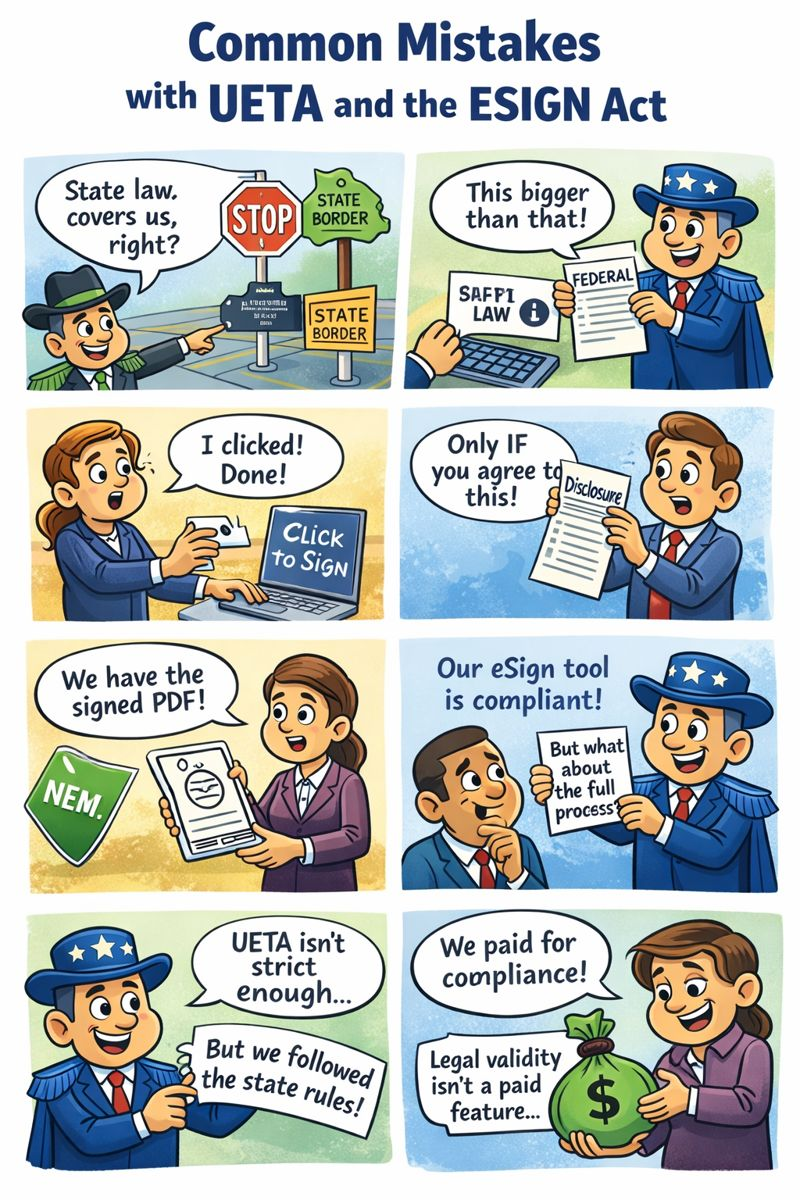
Most electronic signatures compliance issues stem from assumptions, not bad intentions. Teams assume the tool handles everything, consent is automatically implied, and a signed PDF guarantees legal safety. That’s where enforceability quietly breaks down. Consent also has to be freely given, so an agreement signed under duress stays challengeable no matter how clean the audit trail.
- Assuming UETA covers everything: UETA stops at state borders; ESIGN applies the moment transactions go multi-state or consumer-facing
- Confusing signatures with consent: A click-to-sign is not ESIGN-compliant consent unless disclosures and affirmative agreement are captured
- Ignoring audit trails: Signed documents without traceable records weaken enforceability during audits or disputes
- Relying on standalone eSignature tools: Compliance depends on the full workflow, not just the signing moment
- Designing for UETA instead of ESIGN: ESIGN is stricter and sets the higher compliance bar
- Overpaying for “compliance”: Legal validity comes from process and transparency, not expensive pricing tiers or hidden fees
How Docupilot makes UETA and ESIGN compliance simple and predictable
UETA and ESIGN compliance depends on how workflows capture consent, preserve intent, and retain records at scale. Docupilot builds those requirements directly into document automation, so compliance happens by default and consistently, as document volumes grow.
- Built for UETA and ESIGN Act compliance by design: Docupilot supports electronic signature workflows that align with both state and federal requirements. It captures intent, links signatures to documents, and ensures long-term accessibility.
- Clear audit trails and record retention: Docupilot automatically logs key metadata for every document, including signer identity, timestamps, document versions, and activity logs. This creates a complete audit trail that supports ESIGN’s enforceability standards.
- Captures intent and consent: Every signature workflow built in Docupilot explicitly records signer intent and consent. This includes affirmative actions tied to disclosures, signer confirmations, and digital acknowledgements, aligned with ESIGN’s standards.
- Streamlined document retention and version control: Docupilot maintains centralized, accessible storage for all signed records. Documents are versioned automatically, helping teams meet legal retention requirements while maintaining consistency across workflows.
- Support for dynamic lists in contracts: By combining document generation, automation, and electronic signatures in a single platform, Docupilot simplifies compliance across the entire document lifecycle.
- Transparent pricing: Docupilot offers transparent pricing with no hidden fees. Features like audit trails, document storage, and workflow automation are available without surprise add-ons or usage-based penalties that inflate costs over time.
How Docupilot Streamlines UETA & E-Sign Act Operations?
UETA and the ESIGN Act together define how electronic signatures gain legal recognition in the United States. One operates at the state level. The other provides federal consistency. For businesses, the real priority stays the same: electronic signatures must reflect clear intent, informed consent, and reliable records.
If your team uses electronic signatures alongside automated document generation, compliance clarity matters. Docupilot’s workflows are built to meet ESIGN Act standards, which by default cover UETA requirements, reducing compliance complexity at scale.
Start your free trial or book a personalized demo to see how Docupilot keeps eSign compliance simple, transparent, and built into every workflow.
FAQs
1. Are electronic signatures legally binding in the US?
Yes. Electronic signatures are legally binding under both the UETA and the ESIGN Act, provided signer intent, consent, and record retention requirements are met.
2. What is the main difference between UETA and the ESIGN Act?
UETA governs in-state transactions. ESIGN covers multi-state and online agreements under federal law.
3. Should businesses follow UETA or the ESIGN Act?
Businesses should align workflows with ESIGN Act requirements. Following ESIGN guidelines typically ensures UETA compliance as well.
Learn how to automate document creation with Docupilot


Contents
Stop rebuilding the same document by hand.

Generate and sign documents in one workflow
Save ~15 minutes per application