





Key takeaways
- Manufacturing document generation is a core production activity that affects throughput, approvals, and shipment readiness
- Manual document workflows create hidden delays through rework, approval queues, and poor version control
- Automated document generation keeps work orders, quality records, and compliance documents aligned with live production data
- Tools like Docupilot support manufacturing document generation at scale with standardized workflows and transparent pricing
Production lines often slow down for reasons that have nothing to do with machines or labor. A work order waiting for approval, a quality report stuck in review, or a missing compliance document can pause production even when everything else is ready.
This is where docgen for manufacturing becomes critical. Documents control how production starts, how it runs, and whether finished goods can move forward or ship. When document workflows rely on manual templates, emails, and follow-ups, delays compound quickly.
This post explains what manufacturing document generation is, why manual processes create hidden bottlenecks, and how document automation keeps documentation moving at the same pace as production.
What is manufacturing document generation?
Manufacturing document generation is the process of creating the documents required to run production, maintain quality, and meet compliance requirements. These documents control how work starts, how it’s executed, and whether it’s legally acceptable to ship the product.
In modern plants, documents are triggered by events such as a production order release, a quality check, or a supplier change. Manufacturing document generation determines how quickly and accurately those documents are created, approved, and made available to the teams that need them.
Types of documents generated in manufacturing
Manufacturers generate a high volume of documents every day. The most critical ones include:
- Work orders, bills of materials (BOMs), and standard operating procedures (SOPs)
- Quality checklists and inspection reports
- Compliance certificates and audit trails
- Supplier contracts and change orders
Manual vs automated document generation in manufacturing
This side-by-side view below highlights where delays typically appear and how automation removes them.
Why documentation becomes a bottleneck in manufacturing operations
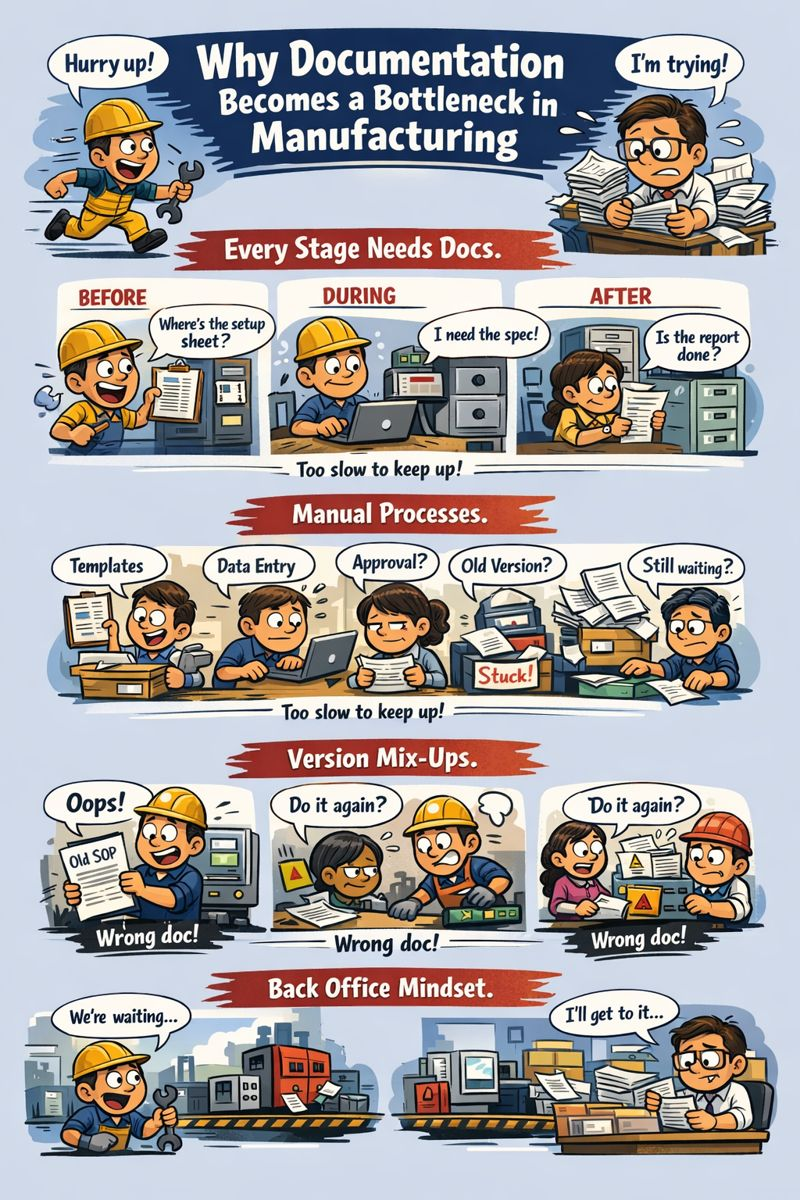
Manufacturing moves fast. Documentation doesn’t. That mismatch is the problem.
The causes of these delays fall into a few repeatable patterns.
1. Documentation runs across the entire production lifecycle
From planning to quality checks and shipment, documentation is involved at every stage. When it is treated as a side task instead of part of the production system, delays accumulate quickly.
2. Manual processes can’t keep up with production velocity
Static templates, manual data entry, and email-based workflows break down as production scales, creating slow handoffs and inconsistent execution.
3. Approvals and signatures create hidden queues
Documents waiting for review or sign-off often block production quietly. These invisible queues delay work even when materials and operators are ready.
4. Poor version control leads to rework and stoppages
Outdated SOPs, incorrect checklists, and conflicting document versions force corrections, modify, and unplanned production pauses.
Missing documents often lead to rework. Business.com reports that 83% of employees have had to recreate documents they could not locate.
6. Documentation is treated as a side task
Documentation is still treated as back-office work while it is an integral part of the production system. When docgen for manufacturing challenges involves manual, fragmented, and slow processes, it becomes the weakest link in operations.
Also read: How Automated Document Generation Is Transforming Insurance Operations?
How document automation removes workflow bottlenecks
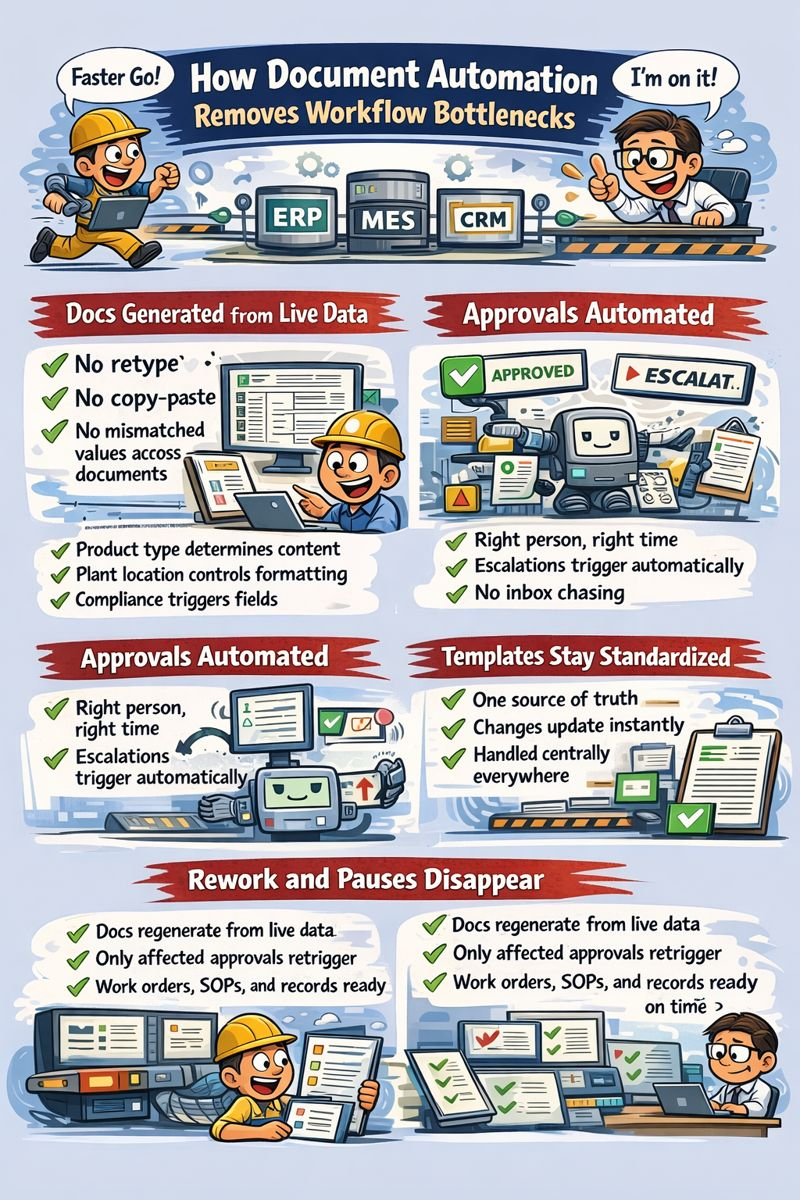
Document automation removes delays by changing how documents are created, routed, and approved.
Here’s how:
Data-driven document creation
Automated document generation creates documents directly from live data in source systems such as ERP, MES, or CRM. This removes manual re-entry, copy-paste errors, and mismatches across documents, keeping documentation aligned with production activity.
Rule-based content control
Rules determine what content appears in each document based on factors like product type, plant location, or compliance requirements. This removes manual decision-making and keeps documents consistent without slowing production.
Automated approvals and signatures
Documents are routed automatically to the right reviewers based on predefined rules. Approvals and electronic signatures happen within the workflow, eliminating inbox chasing and approval queues.
Also read: Are Electronic Signatures Legally Binding?
Centralized version control
Automation ensures documents are always current by instantly updating them across teams and locations, eliminating rework from outdated templates.
Also read: Insurance Document Automation: A Complete Guide for Carriers, MGAs, and Claims Teams
Impact of automated documentation on shop floor efficiency
Shop floor efficiency drops when operators are ready to work but documents are missing, outdated, or waiting for approval. Automated documentation removes these pauses by keeping paperwork aligned with production activity.
- Continuous production flow with fewer waiting points: Automated documents are generated and approved as part of the workflow, reducing pauses caused by missing work orders or sign-offs.
- Fewer errors, less rework: Documents created from live data stay consistent across teams, helping operators and QA work from accurate instructions and criteria.
- Faster issue resolution: Teams can quickly identify and resolve issues without searching emails or shared folders for the latest version.
- Consistent execution across shifts and plants: Standardized templates and centralized control remove variation between locations, shifts, and teams.
Real manufacturing use cases where automation prevents delays
Docgen for manufacturing use cases shows its value where production complexity is highest.
New product introduction (NPI)
NPI triggers a surge of work instructions, SOPs, and quality documents that change frequently. Manual updates slow launches and create approval backlogs. Automated document generation updates and routes documents instantly as specifications change.
Production orders and work instructions
Production orders often change due to demand shifts or material availability. Manual updates lead to outdated instructions reaching the shop floor. Automation regenerates work orders and SOPs directly from live data so operators always work from current versions.
Quality checklists and inspection reports
Manual quality reports delay production when reviews and signatures lag behind inspections. Automated document generation creates inspection reports immediately and routes them for approval without interrupting production flow.
Compliance and regulatory documentation
Regulated manufacturers must produce batch-specific certificates and audit trails. Manual preparation causes last-minute delays before shipment. Automation generates compliant documents on demand with full traceability.
Supplier contracts and change orders
Supplier updates often stall procurement when documentation lags behind changes. Automated document generation creates revised contracts and change orders as soon as terms are updated, keeping suppliers and internal teams aligned.
Batch records and traceability documents
Batch records must be complete before product release. Missing or inconsistent documentation delays shipment. Automated docgen keeps batch documentation complete and available in real time.
Measuring time and efficiency gains from document automation
To understand the value of document automation, manufacturers need to measure where time is currently lost and how automation delivers clear, trackable gains.
Here’s where manufacturers can see the numbers move.
- Document turnaround time: Automated manufacturing document generation reduces document creation and finalization from hours or days to minutes.
- Approval cycle time: Structured approval workflows replace inbox-based sign-offs, cutting approval delays and improving visibility into bottlenecks.
- Rework and correction rates: Documents generated from live data reduce errors caused by manual entry and mismatched values across systems.
- Production downtime caused by documentation: Automated document workflows prevent stoppages linked to missing approvals, outdated SOPs, or incomplete compliance records.
How Docupilot helps manufacturers eliminate documentation delays
Docupilot helps manufacturers remove documentation delays by embedding document generation directly into production workflows. This tool integrates with CRM and ERP systems through Zapier and Make, connecting with over 1000+ apps enabling teams to manage critical documents as part of the process itself.
1. Built for high-volume manufacturing document generation
Docupilot generates production, quality, and compliance documents directly from structured data using predefined rules. This supports high document volumes without manual intervention or workflow breakdowns.
Case Snapshot:
5HC Systems automated complex, data-heavy PDF documents after manual templates and workarounds failed to scale. Using Docupilot, documents are now generated directly from structured data, reducing manual effort and supporting higher volumes without added overhead.
2. Automated reviews, approvals, and e-Signatures
Reviews and approvals are handled inside the document workflow, with roles and routing defined upfront. Built-in electronic signatures streamline the review process and prevent delays from missed approvals.
3. Centralized version control across teams and plants
Docupilot enforces a single source of truth for templates and documents. Updates apply instantly across locations, so operators, QA, and compliance teams always work from the latest approved versions.
4. Transparent pricing with no hidden costs
Many manufacturers combine workflow tools with separate e-signature products, leading to layered pricing and unexpected costs over time.
Docupilot offers transparent pricing with core automation, bulk document generation, and e-signatures included. There are no per-workflow surprises and no forced upgrades to unlock essential functionality.
5. Fast to deploy, easy to scale
Docupilot does not require heavy IT involvement. Operations teams can build, update, and manage document workflows themselves.
Keeping production moving by fixing documentation
Production delays are often traced back to machines, labor, or suppliers. In many cases, documentation is the constraint. Manual manufacturing document generation slows approvals, creates version issues, and forces production teams to wait.
Document automation removes that friction by keeping documentation in step with production. Work orders, quality reports, compliance records, and supplier documents are generated and approved without manual handoffs.
Docupilot helps manufacturers do this without heavy IT involvement or unpredictable costs. Operations teams manage workflows themselves, and transparent pricing supports automation at scale.
Book a demo, or start a free signup and see how Docupilot automates manufacturing document generation without hidden costs.
FAQs
What is manufacturing document generation?
Manufacturing document generation is the creation of production, quality, and compliance documents using structured data. These documents control approvals, execution, and shipment readiness across manufacturing workflows.
Why does manual document generation cause production delays?
Manual document generation depends on templates, copy-paste, and email approvals. This leads to rework, version errors, and approval queues that quietly slow production.
How does automated document generation reduce delays?
Automated document generation pulls data from source systems, creates documents instantly, and routes them for approval. Documentation stays aligned with production instead of blocking it.
How does Docupilot support manufacturing document generation?
Docupilot automates document creation, approvals, and version control from a single platform. Manufacturers scale document workflows with transparent pricing and no hidden costs.
Learn how to automate document creation with Docupilot


Contents
Stop rebuilding the same document by hand.

Generate and sign documents in one workflow
Save ~15 minutes per application