

Key takeaways
- eSignatures streamline processes and ensure compliance: eSignature solutions meet global regulatory standards, providing wealth management firms a secure and compliant method for handling documents
- Digital transformation drives efficiency: eSignatures eliminate manual processes, reducing time spent on paperwork and enabling wealth managers to focus on higher-value tasks
- Client trust and ease of use are essential: eSignature solutions offer clients a seamless, fast, and secure signing experience, enhancing satisfaction and ensuring smooth onboarding
- The right platform supports scalability: Platforms like Docupilot integrate with existing systems, enabling wealth management firms to scale without disrupting their operations or sacrificing compliance
Most wealth management firms don’t feel a single point of failure in their document workflows. What they feel instead is drag: slower onboarding, more follow-ups, version confusion, and growing compliance exposure.
Every manual signature step adds time. Every resend introduces risk. And as client volume grows, those small inefficiencies compound into real operational cost.
Clients now expect agreements to move as fast as the rest of their financial lives. Regulators expect clear audit trails and consistent execution. Manual and semi-digital workflows make both harder to deliver at scale.
eSignature solutions for wealth management address this gap by enabling faster execution, stronger compliance controls, and operational efficiency without disrupting client trust or regulatory integrity. This post examines how eSignatures are reshaping wealth management in 2026, where they create the most impact, and what firms should evaluate before adoption.
Why 2026 is a tipping point for wealth management firms
By 2026, three pressures collide:
- Higher client volume per advisor
- Tighter regulatory scrutiny
- Lower tolerance for onboarding delays
High-net-worth clients still value relationships, but patience for paperwork is gone. Delays in onboarding, disclosures, or mandate updates directly affect confidence and retention.
At the same time, many generic eSignature tools struggle in regulated environments. They’re built for one-off approvals, not multi-party agreements, recurring updates, or jurisdiction-specific rules.
Purpose-built eSignature platforms address this by embedding signing into controlled workflows, with visibility, approvals, and auditability baked in.
Where eSignature solutions create the most impact
Most people think of eSignatures as a faster way to collect approvals. In wealth management, their impact goes much deeper.
eSignature solutions centralize agreement execution, standardize consent capture, and ensure that every signed document is defensible from a compliance standpoint. The greatest value emerges where speed, accuracy, and regulatory accountability intersect.
Streamlined client onboarding and agreement workflows
Onboarding is one of the most document-intensive stages in wealth management. Advisory agreements, KYC documentation, disclosures, and investment mandates often require multiple signatures and approvals. Manual or semi-digital processes, including printing, scanning, resending, and reconciling versions, cause delays at each step.
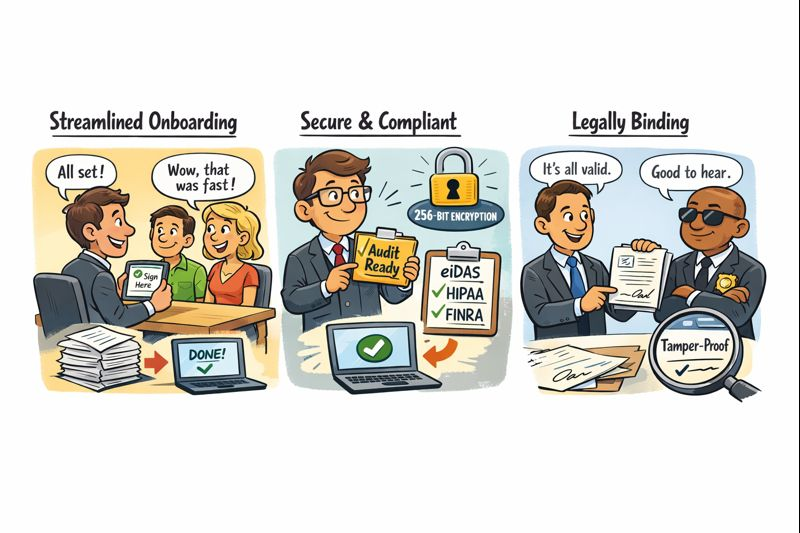
eSignature solutions for wealth management streamline this process by keeping document generation, signing, and storage in one place. Advisors activate accounts faster. Clients experience fewer back-and-forths. Ops teams spend less time chasing status.
Ensuring security and compliance
In regulated environments, “signed” isn’t enough. Firms need to show:
Who signed
- When they signed
- What version they saw
- What changed, and when
Modern eSignature platforms capture this automatically. They incorporate encryption, two-factor authentication, and audit trails, ensuring that all signed documents are tamper-proof and legally binding. They also comply with global regulations such as eIDAS, HIPAA, and FINRA, ensuring wealth management firms that their processes are secure and compliant.
What to look for in an eSignature platform for wealth management
There are several eSignature tools available in the market, but most of these are built for generic business use, not regulated financial environments. They work fine until compliance, scale, or complexity enters the room, and may gradually show some cracks.
Security and audit depth
To support regulated workflows at scale, an eSignature platform should provide:
- Encryption and multi-factor authentication
- Tamper-proof audit logs across the full document lifecycle
Usability for clients and teams
- Clear signing flows
- No learning curve for clients
Seamless integration with existing systems
If your eSignature tool doesn’t connect to your CRM or document systems, it becomes another place errors hide.
The right platform pulls data directly from source systems, generates documents automatically, and stores signed versions without manual steps.
Customization and brand consistency
A wealth management firm’s digital presence is just as important as its physical one, and eSignatures should align with the firm’s branding. The right platform allows firms to customize the look and feel of documents, ensuring consistency with their brand identity.
Strong eSignature solutions for wealth management allow firms to customize templates, workflows, and branding, ensuring documents are consistent, professional, and intentional.
Operational efficiency gains that actually show up on the balance sheet
Removing manual document steps reduces:
- Onboarding cycle time
- Rework caused by errors
- Advisor and ops hours spent on coordination
Advisors spend less time coordinating paperwork and more time focusing on higher-value advisory tasks, improving client satisfaction.Operations teams shift from document chasing to exception management. Legal and compliance teams gain faster visibility into agreement status without repeated follow-ups.
Case studies and real-world applications
Several wealth management firms have already experienced the transformative power of eSignature solutions.
For instance, Sunnon and Charlotte Property Management, based in Charlotte, NC, faced inefficiencies with their lease generation process. The firm spent hours manually generating leases, and document quality suffered due to poor merges. By adopting Docupilot, they streamlined the workflow, cutting lease time and eliminating errors.
Key results:
- 80% reduction in lease preparation time
- 100% high-resolution, legible documents
- Zero manual errors, improving tenant satisfaction
Overcoming digital adoption barriers in traditional wealth firms

Despite the benefits of eSignatures, hesitation towards adoption remains common. 37% of non-adopters worry that clients may be uncomfortable with digital signatures, while 36% express concerns about security and compliance, and 33% question the legal validity of eSignatures.
1. Managing paper preferences and digital adoption gaps
Some clients and advisors still prefer paper-based workflows, particularly in high-touch advisory relationships.
Modern eSignature solutions support hybrid workflows, enabling firms to accommodate varying levels of client and advisor comfort with digital signing. As clients experience faster execution and clearer communication over time, digital signing becomes the default, without sacrificing trust or service quality.
2. Balancing technology change without operational disruption
Another common concern is implementation risk. Wealth management firms operate in regulated environments where process changes must be controlled and predictable.
A good eSignature platform offers phased rollouts. Firms can start with specific use cases, such as onboarding agreements or disclosures, before expanding across the organization. Clear documentation and minimal training requirements help ensure adoption without interrupting day-to-day operations.
3. Addressing compliance and legal approval cycles
Internal compliance and legal reviews often slow adoption, especially when new tools touch regulated client agreements.
Platforms designed for regulated environments address these issues through standardized audit trails, configurable controls, and clear compliance documentation.
4. Aligning stakeholders across advisory, operations, and IT
Document workflows often span multiple teams, creating fragmented ownership.
eSignature solutions are most effective when positioned as shared infrastructure, with clearly defined responsibilities across advisory, operations, compliance efficiency, and IT, ensuring consistent usage and measurable impact.
5. Concern about data residency and scalability
For firms operating across regions, data storage, residency, and long-term scalability are legitimate concerns.
Modern eSignature platforms provide transparency around data handling and are built to scale with growing client volumes, new markets, and evolving regulatory requirements.
Why wealth management teams choose Docupilot for eSignatures
Docupilot is a powerful and reliable platform that addresses both industry-specific needs and common adoption challenges.
Here’s how:
- End-to-end document workflows: Docupilot combines eSignature functionality with document automation, allowing firms to generate, execute, and manage agreements within a single, controlled workflow.
- Security and compliance: Docupilot ensures that all digital signatures and documents comply with global regulatory standards, such as eIDAS and FINRA, so firms can confidently manage sensitive financial documents without the risk of non-compliance
- Faster, more consistent client onboarding: Advisory agreements, disclosures, and onboarding documents can be generated dynamically from internal data, reducing turnaround time and manual errors.
- Automation that scales with firm complexity: As client volumes increase or firms expand into new markets, Docupilot ensures document workflows from becoming operational bottlenecks.
- Seamless integration with existing systems: APIs and integrations allow Docupilot to fit into current CRMs, portfolio tools, and back-office systems without disrupting workflows.
- Preserves client trust and brand consistency: Branded documents and predictable signing flows reinforce professionalism while delivering a smooth, digital-first client experience.
- Reduces administrative load across teams: Advisors spend less time on paperwork, operations teams gain visibility into execution status, and compliance teams maintain confidence in governance.
Building scalable, compliant wealth operations
eSignature solutions have moved beyond convenience into foundational infrastructure for modern wealth management. By tightening document workflows, firms reduce risk, improve onboarding metrics, and free teams to focus on higher-value work.
Docupilot helps wealth management teams modernize execution without compromising compliance.
Docupilot helps you to verify your electronic signatures instantly. Try our brand new esign validate tool today
See how it works. Start a free trial.
FAQs
What are the best practices for integrating eSignature solutions with wealth management systems?
Focus on choosing a platform with robust integration capabilities, ensuring seamless connectivity with your CRM, document management, and other systems for smooth workflows.
How can eSignature solutions improve compliance in wealth management?
eSignatures help firms comply with global regulations by providing tamper-proof audit trails, secure document storage, and ensuring legally binding agreements in line with standards like eIDAS and FINRA.
What are the cost implications of adopting eSignature solutions in wealth management, and what is the return on investment?
While the initial setup may involve a small investment, the time savings, reduced error rates, and improved client experience quickly offset the cost, offering a strong return on investment.
Can eSignature platforms be customized for different wealth management strategies?
Yes, eSignature solutions like Docupilot are highly customizable, allowing firms to tailor document templates, workflows, and branding to suit their specific operational needs.
How do eSignature solutions enhance the client experience in wealth management?
eSignatures offer clients a fast, convenient, and secure way to sign documents from anywhere, improving engagement and reducing friction during the onboarding process.
Learn how to automate document creation with Docupilot


Contents
Stop rebuilding the same document by hand.

Generate and sign in one workflow.
Fifteen minutes back, per application.