





Key takeaways
- SignNow's app plans cost $8 (Business), $15 (Business Premium), and $30 (Enterprise) a month, billed yearly. The Site License is quote-based, starting at $1.50 per invite.
- API plans are priced separately, with a free Dev Mode and a 250-invite Trial. Professional starts at $146 a month for 1,000 invites a year, billed as $1,750 upfront.
- App plans include 100 signature invites a year. Extra invites cost $0.96 on Business, $1.80 on Business Premium, and $3.60 on Enterprise.
- API plans are paid yearly upfront, while app plans automatically bill additional invites after the included allowance is used.
- SignNow fits teams that sign finished files. If your documents must be built from your data first, consider Docupilot. We include API access in every plan, and we price plans by the number of documents delivered.
SignNow’s Business plan starts at $8 per user per month when billed annually. Business Premium is $15, and Enterprise is $30. There is another plan called Site License. It's a quote-based usage pricing that SignNow markets from $1.50 per invite, with discounts for higher volumes.
What do SignNow’s API plans cost?
SignNow offers four API plans: Dev Mode, Trial, Professional, and Enterprise.
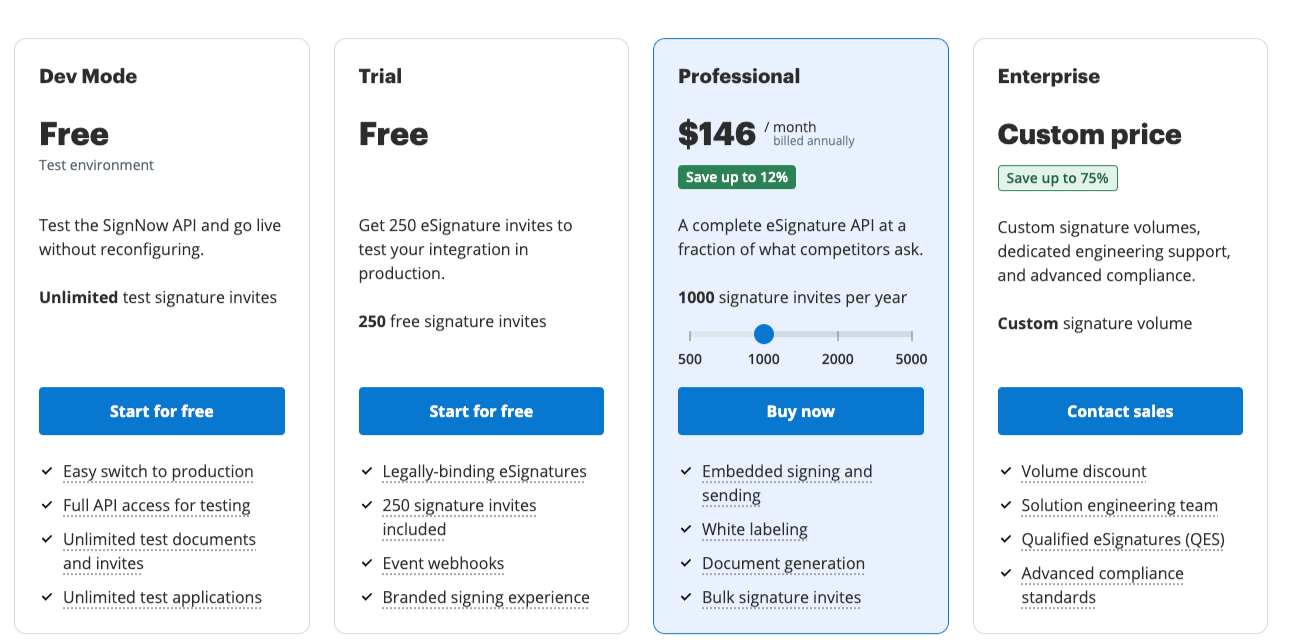
1. SignNow Dev Mode API plan: $0 per year
The Dev Mode plan gives you complete API access in a test environment, with up to 500 test signature invites per account. This is separate from the 250 legally binding invites included with the API trial. The plan suits developers who want to build and test an integration before paying.
Keep in mind the documents signed in Dev Mode aren't legally binding and carry a watermark. Document generation and audit trails run in test mode only.
If you want event webhooks and white labeling, you'll need to upgrade your plan.
2. SignNow Trial API plan: $0 for 250 invites
The Trial plan includes 250 signature invites in production. This means you can test your integration with real signers using legally binding eSignatures. It also adds event webhooks and a branded signing experience, which was not available in the previous plan.
This plan suits teams that want to test their integration in a live environment.
After the trial allowance is used, you need a paid API plan to continue sending production invites.
3. SignNow Professional API plan: $146 per month
The Professional plan includes 1,000 signature invites per year. Under annual billing, you pay approximately $1,750 at checkout, before taxes.
This plan includes embedded signing and sending, white-labeling, bulk signature invites, and document generation.
Based on how many invites you send each year, here is an estimate of how much you pay:
- 500 invites: $84 per month, or $1,008 per year.
- 1,000 invites: $146 per month, or $1,750 per year.
- 2,000 invites: $250 per month, or $3,000 per year.
- 5,000 invites: $500 per month, or $6,000 per year.
If you send more than 5,000 invites a year, it's best to choose the Enterprise plan.
4. SignNow Enterprise API plan: Custom pricing
With the Enterprise plan, you can set a custom signature volume. With volume and non-profit discounts, you can save up to 75% with this plan.
It's also the only plan with advanced compliance options, such as QES, HIPAA support through a BAA, and 21 CFR Part 11. These can help if your business handles healthcare data, FDA-regulated records, or needs stronger signer verification. You can also work with SignNow’s solution engineering team to set up your workflow.
But these are paid add-ons.
This plan suits industries and teams sending more than 5,000 invites a year.
SignNow app pricing by plan options for 2027
SignNow offers four pricing tiers. Here's the current SignNow pricing structure as of 2027.
- The Business plan is $8/user/month on annual billing.
- Business Premium is $15/user/month on annual billing.
- Enterprise is $30/user/month on annual billing.
- The Site License uses quote-based pricing at $1.50/invite, with discounts available for larger volumes.
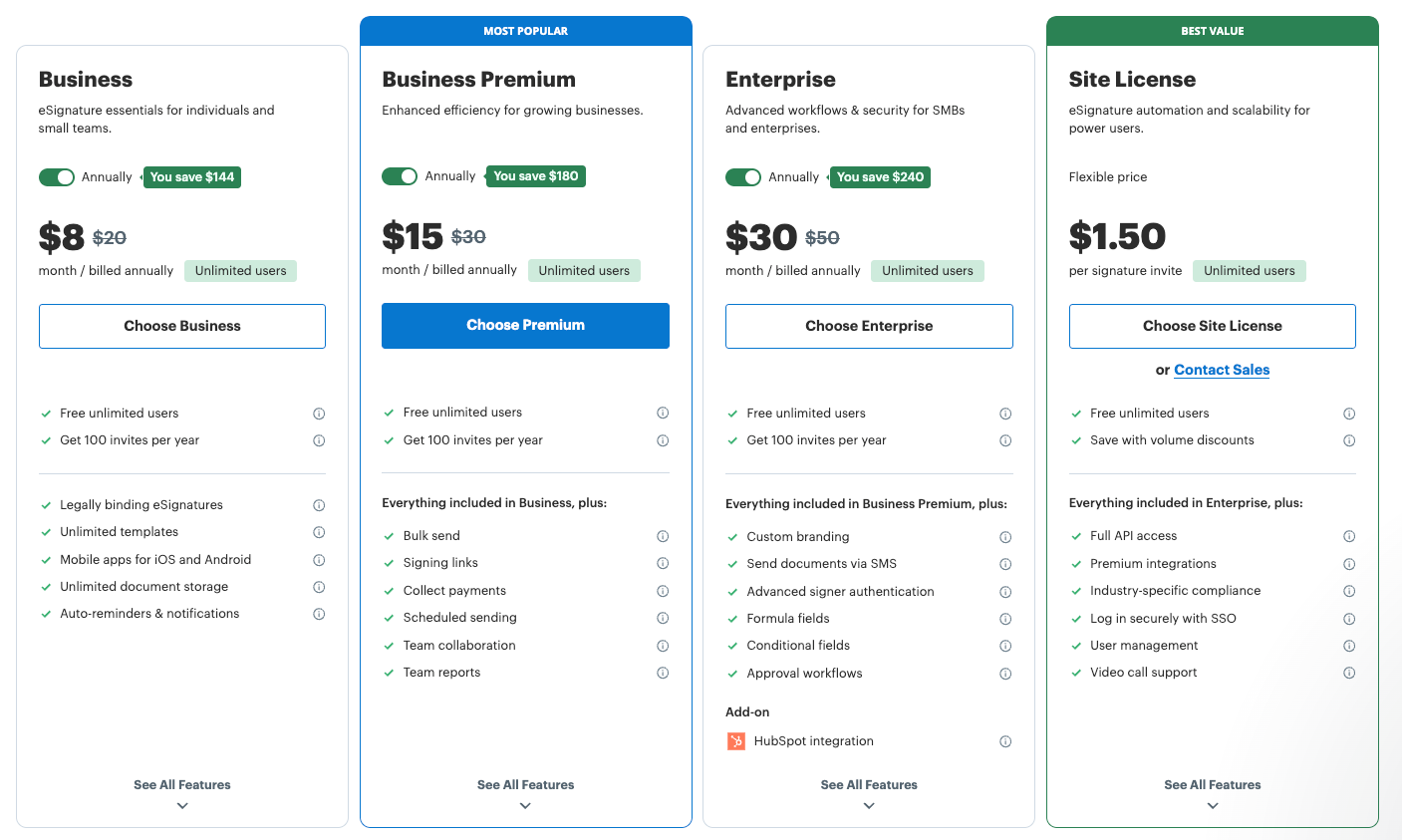
1. SignNow Business plan: $8 per month
The Business plan is SignNow’s entry-level plan. At $8 per user per month with annual billing, it includes basic eSignatures, fillable fields, unlimited templates, audit trails, mobile apps, Google Drive and Dropbox integrations, and reminders.
For bulk sending, CRM and ERP integrations, API access, custom branding, advanced authentication, and reporting, you'll need a higher plan.
Since SignNow includes unlimited user seats on all paid plans, adding team members does not increase the subscription cost. The Business plan costs $96 per year and includes 100 signature invites shared across the account. Once you reach the 100-invite limit, you can purchase additional invites for $0.96 each.
2. SignNow Business Premium Plan: $15 per month
Business Premium includes everything in the Business plan, along with bulk sending, scheduled reminders, shareable signing links, document groups, payment requests, and conditional routing.
It still doesn't include API access, custom branding, advanced signer authentication, signer attachments, conditional fields, calculated fields, or HIPAA support. If you need these specifically, you'll need to upgrade to a higher plan or pay for add-ons.
The Business Premium plan costs $240 per year and includes 100 signature invites shared across the account. Once you reach the 100-invite limit, you can purchase additional invites for $1.80 each.
3. SignNow Enterprise Plan: $30 per month
You get custom branding, advanced authentication, conditional fields and routing, calculated fields, signer attachments, reporting and analytics, and advanced threat protection.
It doesn’t include embedded API access, CRM or ERP integrations, HIPAA support through a BAA, industry-specific compliance packages, or QES. These are available through the Site License.
With annual billing, you pay $360 per year. The plan includes up to 100 signature invites per year, shared across the account. Additional-invite pricing varies by plan.
4. SignNow Site License Plan: $1.50 per invite
With this plan, you don't pay per user. You pay per transaction. This means that there is no limit on the number of users.
It includes full API access for embedded signing and offers CRM and ERP integrations.
The plan also offers compliance options such as HIPAA support through a BAA, industry-specific packages, and QES. Pricing starts at $1.50 per invite, with volume discounts available for higher volumes and custom enterprise packages through their sales team. Because pricing is quote-based, the exact rate your organization pays depends on the terms you negotiate.
If your organization sends 5,000 signature invites per year, you would pay around $7,500. With volume discounts, that pricing drops. Compared with the Enterprise plan for the same 5,000 invites, you pay $360 for the year plus $3.60 per invite, for a total of $18,000 per year. The Site License plan is cost-effective if you have many users with moderate total volume.
Hidden Costs and Limitations in SignNow
1. The 100-invite yearly cap and overage fees
Every SignNow app plan includes 100 signature invites per year. That's about 8 invites a month. Since SignNow includes unlimited users on its paid plans, the whole team shares this allowance.
For example, if your sales team sends proposals and contracts, they can use that up in one quarter. If your HR team onboards 50 new hires, with just two documents each, onboarding alone can use up 100 invites.
Once you go over the cap, you pay for each extra invite, and the rate depends on your plan.
The most expensive plan also has the highest overage rate. For example, if your team sends 600 invites a year on Business Premium, 500 of them are over the cap. That adds $900 to a $180 yearly subscription.
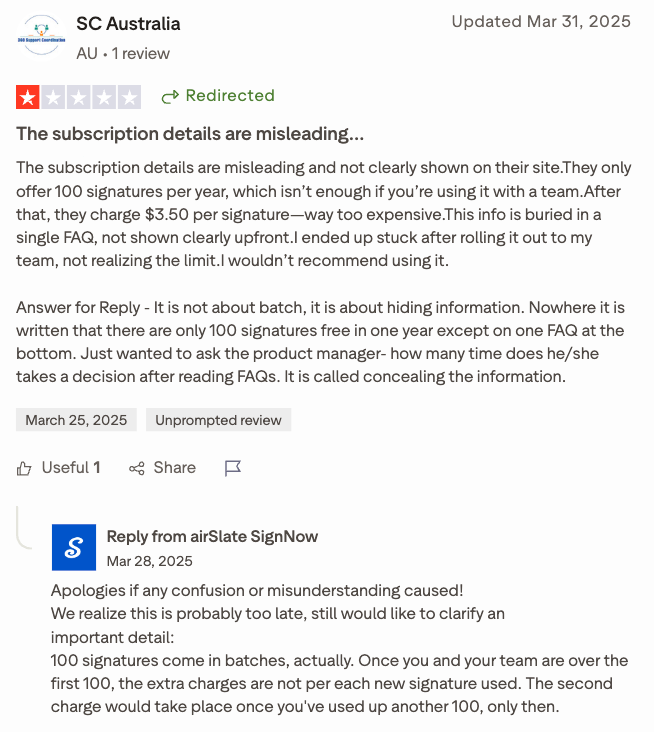
Some users say the cap wasn't clear when they signed up. One Trustpilot reviewer said how SignNow presents its signature limits, saying the 100-signature annual cap and extra charges were buried in an FAQ and weren’t clear at sign-up.
2. Price increases at renewal
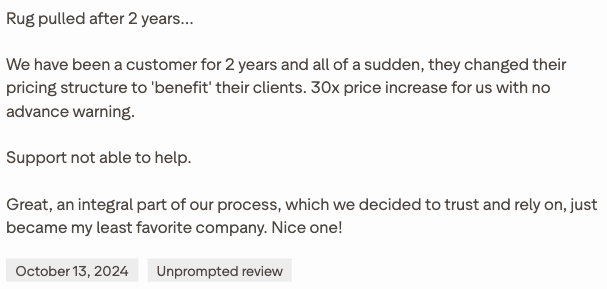
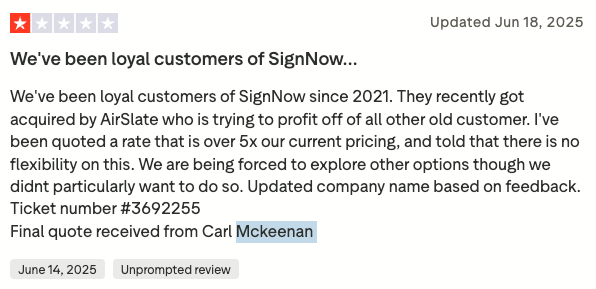
Some SignNow customers report large price increases when their plan renews. In reviews, one long-time customer described a 30x increase with no warning.
Another said they were quoted more than 5 times their current price after airSlate took over SignNow.
3. Monthly billing vs. annual billing
The low prices SignNow shows are annual rates, billed once a year. If you pay monthly, each plan costs more:
- Business: $20 a month, compared with $8 billed annually
- Business Premium: $30 a month, compared with $15 billed annually
- Enterprise: $50 a month, compared with $30 billed annually
That means annual billing saves you $144 a year on Business and $240 a year on Enterprise. Monthly billing makes sense only if you need to cancel at short notice, like for a project-based team.
With API plans, you don't get the choice. You pay $1,750 upfront for the 1,000-invite tier.
4. Features locked behind higher plans
Some features that most growing teams need are only available on higher plans:
- Bulk sending starts on Business Premium.
- Custom branding and advanced signer authentication start on Enterprise.
- Full API access and premium CRM and ERP integrations need the Site License.
- HIPAA support through a BAA also needs the Site License.
So if you start on Business at $8 a month and later need a HIPAA BAA, you'll have to move to the Site License. It's priced per invite and quoted by sales.
5. SignNow API plan limitations
SignNow's API plans also have technical limits that affect how you build and what you pay.
- Request limits: Each production app can make 1,000 API requests per hour by default, or 500 in Dev Mode. Calls over the limit return a 429 error. If you send large batches, use webhooks for status updates and clearly ask the platform if it can increase your limits.
- Signature level: Trial and Professional plans include basic electronic signatures (SES). Enterprise adds advanced electronic signatures (AES), which provide stronger checks on signer identity and document integrity.
SignNow's key features and use cases
SignNow lets you send documents for signature through its web app or API. Here are its main features and the plans that include them.
Pros and cons of SignNow pricing
Here's what works well in SignNow's pricing and what users find frustrating.
Pros
- Unlimited users on paid plans: Each person gets their own account, templates, and permissions at no extra cost. Since every action is tied to a named user, the audit trail shows who created, modified, deleted, or sent each document.
- Low cost for light senders: A solo consultant sending 5 or 6 contracts a month stays under the 100-invite cap. On the Business plan, that's just $96 a year.
- Buy without a sales call: You can compare plans and buy an API plan with up to 5,000 invites a year on your own. Only the Site License and Enterprise API plan need a quote.
Cons
- The invite allowance doesn't grow with your team: A 5-person team and a 30-person team get the same 100 invites a year. Moving to a higher plan adds features, but you do not get extra invites.
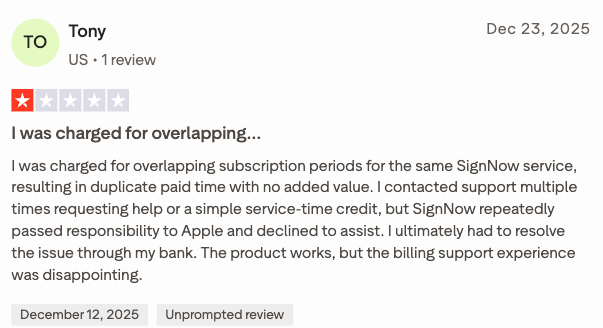
- Billing and account management: One reviewer said they couldn’t remove their saved card without closing their account. Another reported being charged for overlapping subscription periods and said SignNow support referred them to Apple instead of resolving the issue.
- Poor customer support: One Trustpilot reviewer said SignNow was unreliable and that support repeatedly promised an account manager would follow up on their refund request, but no refund was issued.
Docupilot vs. SignNow: Which fits your workflow?
If you're considering a switch from SignNow, here's how we work with your existing templates and data. We'll explain where our approach differs and when we're a better fit for your team.
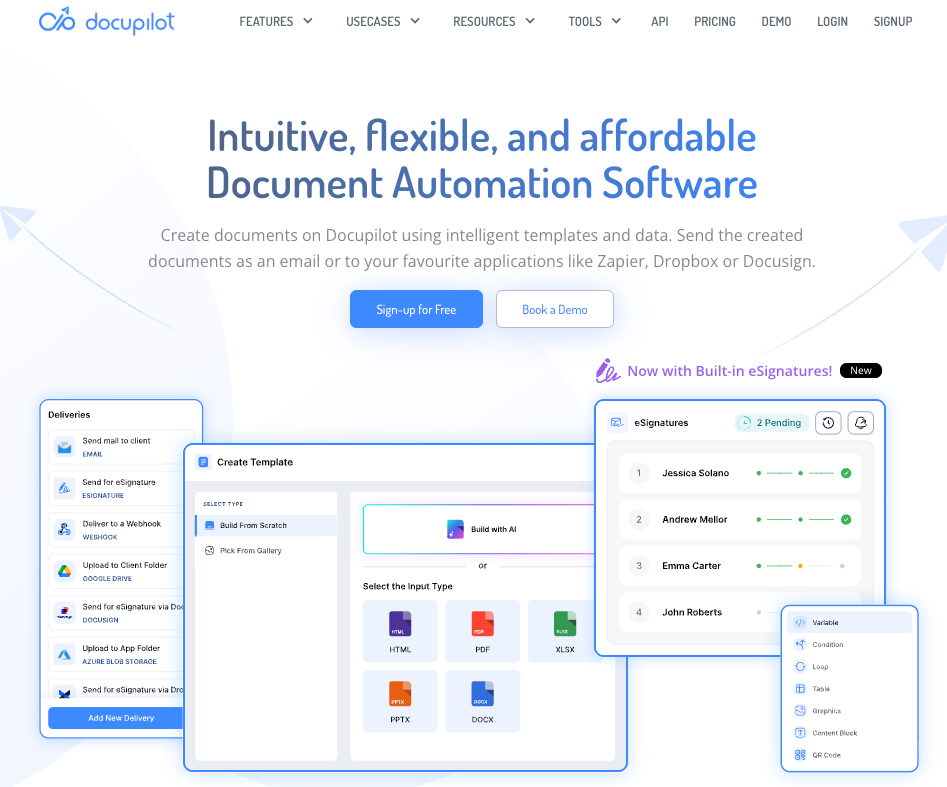
We built Docupilot for teams that create documents from business data, such as contracts, offer letters, invoices, and reports. Once you connect your data to a template, we automatically generate each document. You can also automate how it's processed and where it's sent.
SignNow focuses on signing prepared documents. At Docupilot, we handle the steps that happen before signing. We generate formatted documents from your business data and route them through a workflow. We also add eSignature when you need it.
Our plans are based on documents delivered. Every plan includes API access and a set number of user seats. eSignature is a separate add-on, since not every generated document needs a signature.
SignNow's plans, by contrast, are based on signature invites. If you need API access, it sits on separate API plans or the Site License.
Docupilot pricing and plans
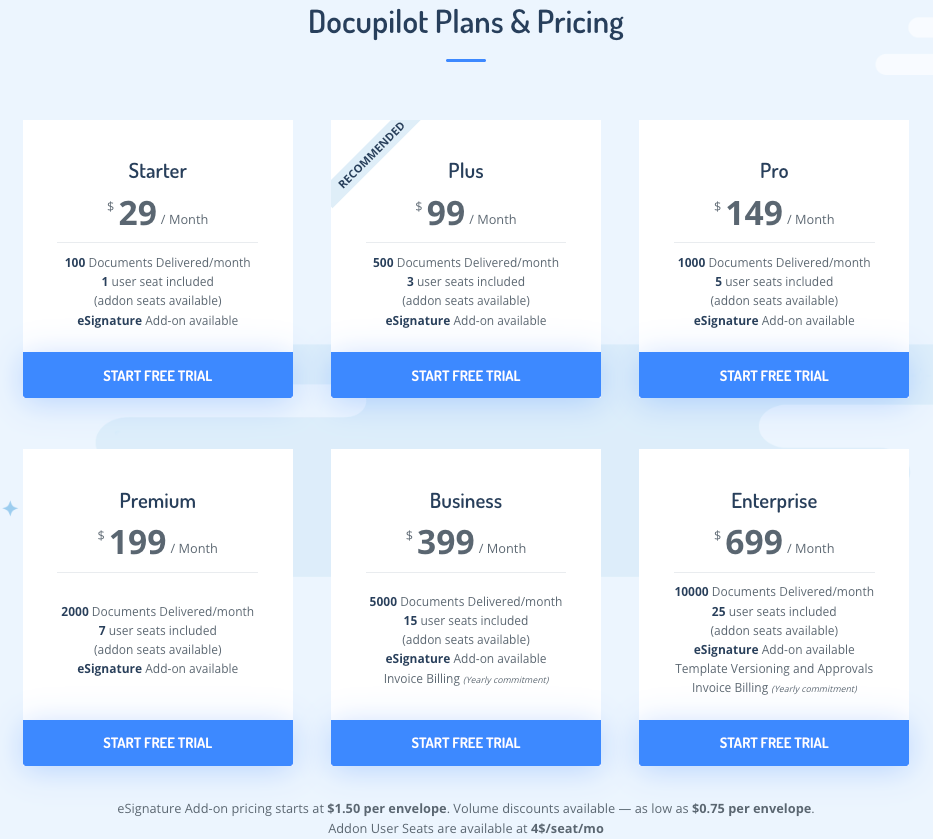
Our listed plans include:
Every paid plan includes API access, unlimited templates and testing, and integrations with Zapier, Make, and Airtable. Business and Enterprise plans also offer invoice billing with an annual commitment.
Our monthly allowance is based on document deliveries. For example, emailing a generated document and saving it to Google Drive count as two deliveries. On standard plans, document generation pauses at the monthly limit unless overage billing has been enabled; otherwise, you can upgrade to continue.
For more information on our pricing, visit our pricing page.
Docupilot vs. SignNow: Pricing and workflow differences
- Pricing: Our plans are based on document deliveries and include a set number of seats. This suits teams with a fixed document volume that need more people to access it. Additional seats cost $4 per month.
SignNow's app plans include unlimited users but a shared allowance of 100 invites a year. Its API plans are sized by yearly invites and paid upfront.
- Who maintains the rules: At Docupilot, your operations team can update templates and document rules without changing your application's integration. This means fewer post-launch code changes.
- Templates and document logic: You can use our editor or upload a Word, PDF, PowerPoint, or Excel template. Conditions and repeatable sections let one template adapt to incoming data. For example, a line-item table can repeat for each item, and a clause can appear only when a data field meets a condition. Teams can update these document rules in Docupilot without changing their application integration. We are known for how simple our process is.
SignNow supports reusable templates created from PDF, Word, and image files. Teams can add fillable fields, prefill values, assign signer roles, set signing order, and configure conditional fields. For API-led document generation, SignNow can generate prefilled PDFs from DOCX templates using tags and data from connected systems.
- Workflow: With our Workflows, one request from your app can pick the right template, generate the document, and send it for signature. Once everyone signs, the completed document automatically goes to Google Drive or triggers the next steps.
SignNow workflows can create a document from a template, prefill fields, route it to signers in sequence or in parallel, and track status through webhooks. The workflow can be managed through the SignNow app or API, depending on the setup.
eSignature is an optional add-on
We offer eSignature as an add-on because not every generated document needs to be signed. If you mainly generate and deliver documents, you can choose a plan around that workflow without paying for signature envelopes you don’t use. When you do need signatures, the add-on starts at $1.50 per envelope, with volume discounts as low as $0.75. One envelope can contain one or more documents.
To send a document for signature, add signature fields to your template and set up the recipients, signing order, and reminders. When we generate the document, we create an envelope and email the signing invitation. You can then track the envelope’s status.
Making the right choice between SignNow and Docupilot
SignNow may suit teams whose main requirement is eSignature. Docupilot may be a better fit for teams that need API-driven document generation, flexible templates, automated delivery, and eSignature in the same workflow. Compare SignNow by expected invite volume and paid feature requirements, and Docupilot by monthly document deliveries and eSignature envelopes.
Our 14-day free trial lets you test API access with your own templates before you commit. You can see how the workflow runs and what still needs manual attention. Book a demo to walk through our platform with our team, and compare the cost with SignNow’s invite limits and overage fees.
FAQs
1. Does sending several documents together count as one SignNow invite?
Yes. SignNow counts one invite when you send a document group to one or more recipients at once through the API. A three-document onboarding packet sent to two signers in one group uses a single invite. Sending the same three documents separately would use three invites.
2. Do unused SignNow API trial invites expire?
Yes. Unused invites from the 250-invite Trial expire after one year. If you don't use all 250, the platform won't charge your credit card. It values the trial invites at $500.
3. Does SignNow offer refunds?
Yes, the platform offers a 30-day money-back guarantee on its app plans page. But before committing to a yearly payment, you must confirm the refund terms for API plans.
4. Are Docupilot eSignatures legally binding?
Yes. Docupilot eSignatures are legally binding for most business documents. They support the ESIGN Act and UETA, and every envelope includes an audit trail with timestamps, IP addresses, and signer authentication details. You can also set the signing order or let people sign in parallel.
Some documents, including wills, court filings, and family-law documents, may have separate signing requirements. Before using eSignatures for these documents, check the rules that apply in your jurisdiction.
5. Can Docupilot handle more than 10,000 documents a month?
Yes. Our plans go up to 10,000 documents delivered a month on Enterprise at $699. For higher volumes, you can email [email protected] to request a custom plan. We price custom plans based on your monthly document volume and the number of seats you need, with eSignature envelopes priced separately.
Learn how to automate document creation with Docupilot


Contents
Stop rebuilding the same document by hand.

Generate and sign documents in one workflow
Save ~15 minutes per application